FocusQ
Fifteen numbers. Tap them in order. The clock is not on your side.
FocusQ is a game of attention. Fifteen numbered bubbles sit in a grid, three across and five down, and you tap them from the smallest to the largest before the time runs out. The first level gives you 35 seconds for 1 to 15. The last gives you six seconds for a board of nothing but sixes and nines.
iPad, iPhone
Free. No account, no ads. Your times stay on your device.
The whole game
Find the smallest number and tap it. The bubble shrinks away with a ring of light and leaves a dark hole. Find the next one. A wrong tap costs you nothing but time: the bubble shudders and buzzes, and the clock keeps running. Clear all fifteen before it reaches zero and the level is yours, with your time to the hundredth of a second.
That is all there is to learn, and it takes one level. The rest is the numbers.
Ten levels
The first two count from 1 to 15, and the second cuts the time to about a quarter. After that the numbers stop being consecutive, so you can no longer look for “the next one”; you have to compare.
| Level | Clock | The numbers | Stage |
|---|---|---|---|
| 1 | 35 s | 1 to 15 | Practice |
| 2 | 9 s | 1 to 15 | Practice |
| 3 | 10 s | 0 to 70, in fives | Practice |
| 4 | 9 s | Tens up to 140, each one sometimes a 1 higher: 30 or 31, 80 or 81 | Hard |
| 5 | 9 s | About seven apart, and different every time | Hard |
| 6 | 5.5 s | 0 to 140, in tens | Hard |
| 7 | 8.5 s | Every number ends in 7, from 7 into the 700s: 357, 427, 457, 527 | Tricky |
| 8 | 9 s | Three digits, from the 100s to the 800s, about fifty apart | Tricky |
| 9 | 7 s | Small numbers crowded together: 0 or 1, 3 or 4, up to 43 | Evil |
| 10 | 6 s | 6, 9, 66, 69, 96, 99, 666, 669, 696, 699, 966, 969, 996, 999 and 999 again | Evil |
Level 10 is the one people remember. Every number is made of sixes and nines, and in a hurry the eye cannot tell 696 from 969. Your eyes say one thing and your finger does another.
Clearing a level opens the next one, and any level you have cleared can be played again for a better time.
Color is a hint, until it isn’t
The bubbles come in three colors, and the colors mean something: the five smallest numbers on the board are blue, the middle five are green, and the five largest are red. So instead of one search through fifteen numbers you can make three searches through five. Once you see it, your times drop.
Then switch on Color Mix. The colors are handed out at random and tell you nothing, and the same level is a different game.
Best times, and a score
Every level keeps your best time. When all ten have one, your times add up to a single score: each level’s time is multiplied by the level’s number, so a second lost on level 10 costs ten times what it costs on level 1. Lower is better.
With Game Center the score goes to a leaderboard, and each level has a leaderboard of its own, so you can see how your 4.71 seconds on level 4 compares. Game Center is optional. Without it the game is whole, and the times you set are kept and sent if you sign in later.
Today’s board
Once a day there is one board that is the same for everyone: the same fifteen numbers in the same places, taken from levels 4 to 10 in turn. It has its own leaderboard, which starts over every day at midnight UTC. Today’s board never touches your best times or the levels you have opened.
Ten achievements
One for your first clear, one for the end of each stage, one for beating level 10 and one for having a time on all ten. Then the hard ones: a level from 4 up without a single wrong tap, level 10 with Color Mix on, level 10 in under five seconds, and seven of today’s boards.
On the iPad
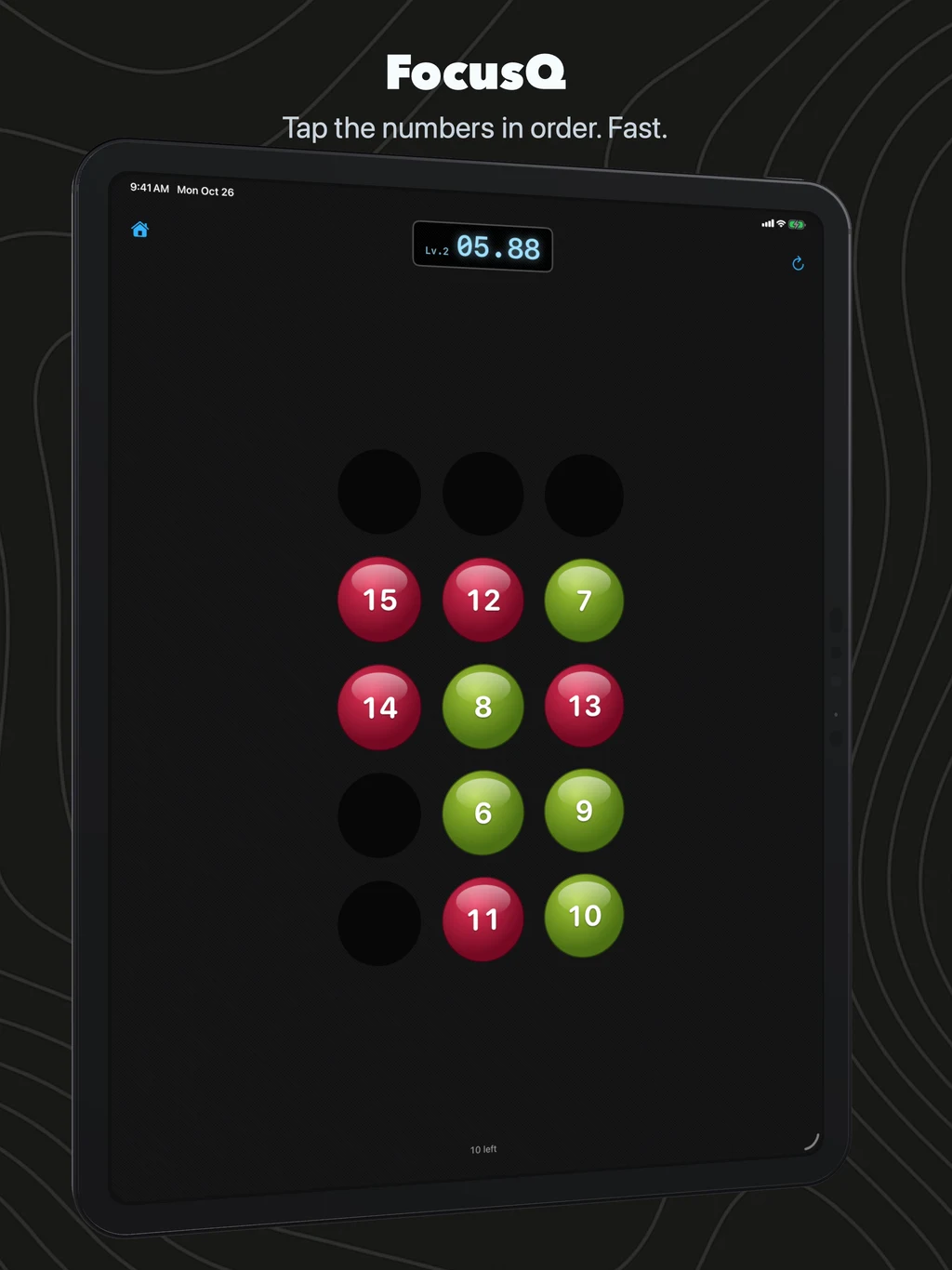
The same board with room around it, any way up.
Privacy
No data is collected. No account, no ads, no analytics. Your best times are kept on the device. The only thing that ever leaves it is a score sent to Game Center, which is Apple’s and which you can leave signed out.
Since 2009
FocusQ first came out in April 2009, in the App Store’s first year. Kiichi and Gavi wrote the game at ObjectGraph and Serge Glikstein drew it: glossy numbered spheres on carbon fiber, with the clock in a little LCD panel. Every written review it got was five stars. “The last level was… evil,” one said. “My fingers hurt from trying to beat level 10,” said another.

This is that game, level for level and number for number, drawn again for today’s screens. The ten levels have the numbers and the time limits they had in 2009.
Questions
How do you play? Tap the fifteen numbers from the smallest to the largest before the clock reaches zero. A wrong tap does not end the level; it only costs time.
What makes the last level so hard? It has only sixes and nines: 6, 9, 66, 69, 96, 99, 666 and so on up to 999, twice. They look alike, and you have six seconds.
How is the score worked out? Each level’s best time is multiplied by the level’s number and the ten results are added. Lower is better, and the later levels weigh the most. The score appears once every level has a time.
Is it a Schulte table? It is a cousin. A Schulte table is a grid of numbers you find in order, usually 1 to 25, with the grid staying as it is. In FocusQ the numbers disappear as you tap them, they are often not consecutive, and a clock is running down.
Will it make me better at concentrating? It is a game, and we make no claim about what it does for your brain. It does ask for all of your attention for six to thirty-five seconds at a time.
Do I need Game Center or a network? No. The levels, the best times and today’s board all work without them. Game Center adds the leaderboards and the achievements.
Can I turn the sound off? Yes, from the menu, and the silent switch mutes it too. Music you are playing keeps playing.
What happened to FocusQ Lite? The Lite was a three-level sample from 2009. FocusQ itself is free now, with all ten levels, so the Lite is no longer on the store.
Is there a subscription or ads? No. It is free, with no ads and no account.
Which devices and languages? iPhone and iPad with iOS 26 or later, in English and Japanese.
The story of bringing it back: FocusQ 2: fifteen numbers, ten levels, seventeen years later.